
If you run a medical practice, you know the pain of denied claims. You do the work. You submit the bill. Then — denied.
But some healthcare specialties suffer much more than others.
So, which healthcare has the highest denial rate?
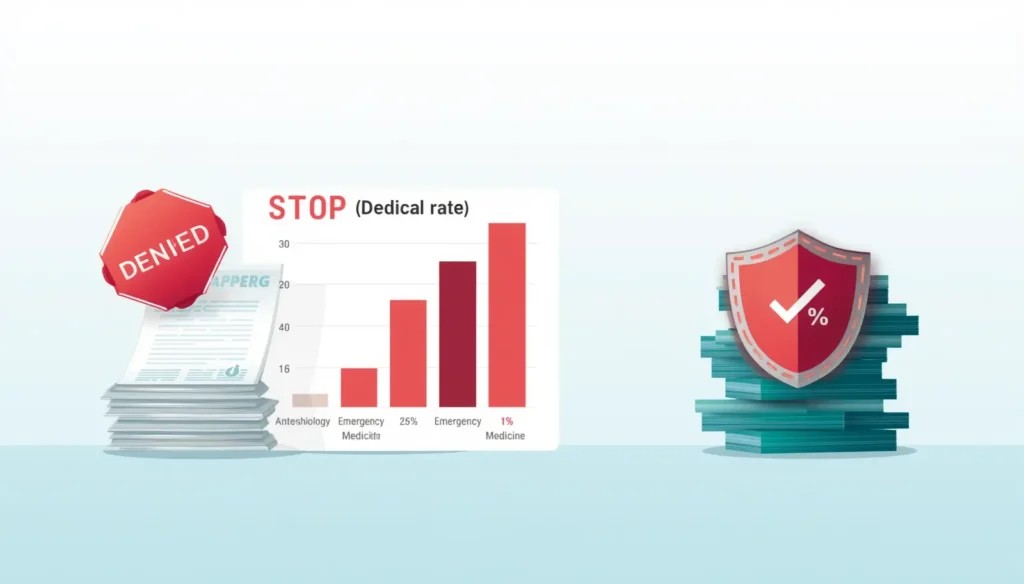
According to the latest industry data (2024-2025), the specialty with the highest initial claim denial rate is Anesthesiology, with denial rates often exceeding 25-30% for some practices.
Close behind are Emergency Medicine and Ambulance/Transportation services.
Let us break down the numbers, why these specialties get denied so often, and — most importantly — how your practice can avoid the same fate.
Why Do These Specialties Get Denied So Often?
The highest-denial healthcare specialties share three common problems:
1. Complex Coding Rules
Anesthesia and emergency medicine use codes that change frequently. Missing a single modifier (like -AA for medical direction) triggers an automatic denial.
2. Prior Authorization Nightmares
Many denied claims in emergency medicine and mental health stem from missing prior authorization. But in an emergency, you cannot get prior auth. That creates constant battles with payers.
3. Medical Necessity Documentation
Payers love to deny claims for “lack of medical necessity” — especially for ambulance transport and chiropractic care. If your documentation does not explicitly justify why the service was needed, denial follows.
The National Average vs. The Gold Standard
Here is some perspective:
- National average denial rate (all specialties): Approximately 10-15%
- Average for the highest denial specialties: 20-30%
- Best-in-class practices (like All State RCM clients): Less than 1%
Yes, less than one percent. How? By doing what most practices do not — proactive denial management.
Real Example: An Anesthesiology Group That Slashed Denials
Consider a 10-provider anesthesiology group in Ohio. Their denial rate was 28% . Most denied claims were due to:
- Missing anesthesia time units
- Incorrect physical status modifiers
- No medical necessity statement
They switched to All State RCM for coding, billing, and denial management.
Within 90 days:
- Denial rate dropped from 28% → 0.8%
- Days in AR fell from 62 → 34
- Recovered $340,000 in previously denied claims
The difference? A dedicated team that reviews every claim before submission and appeals every denial within 48 hours.
How to Lower Your Denial Rate (Even in High-Risk Specialties)
You do not have to accept a 20%+ denial rate just because you are in anesthesiology, emergency medicine, or chiropractic. Here is a simple 4-step plan:
- Audit your top 10 denial reasons. Pull your last 100 denials. What is the #1 reason? Missing modifier? No prior auth? Fix that first.
- Automate eligibility verification. Verify insurance before every visit — even for established patients.
- Use certified coders. Do not rely on software alone. Human coders (especially those with CPC, COC, or CIC credentials) catch errors algorithms miss.
- Appeal every denial within 7 days. Most practices give up too soon. 60-70% of appealed denials are eventually paid.
Or — do what hundreds of US practices have done: Outsource to All State RCM.